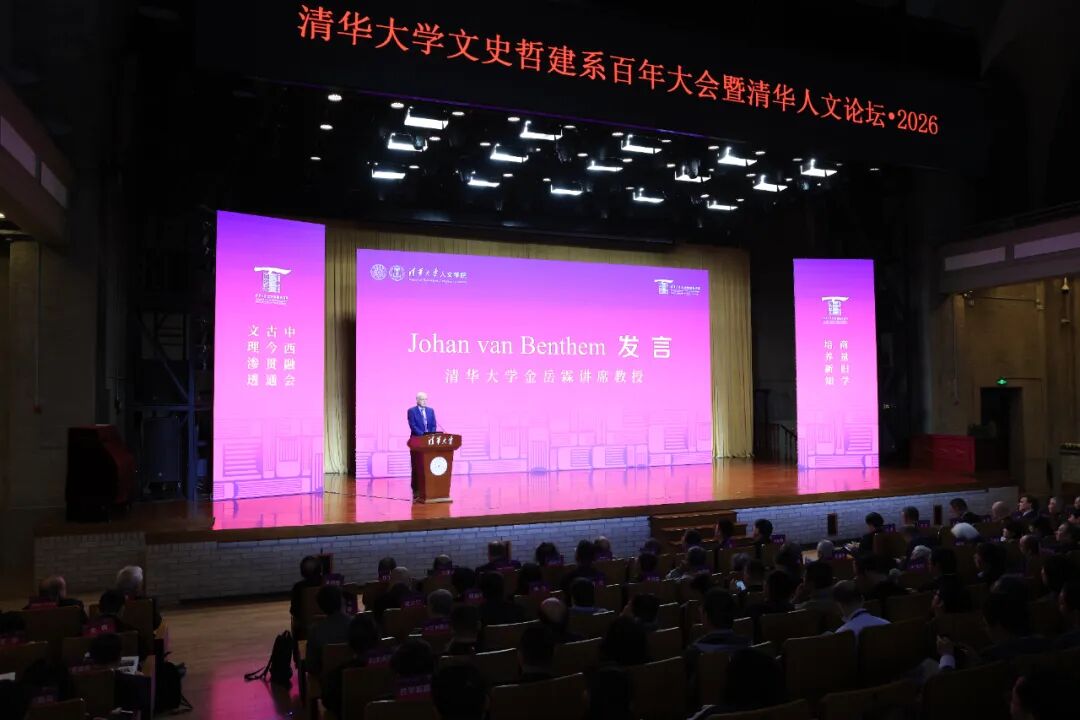
中文版
女士们,先生们:
今天能在清华人文百年庆典上,当着这么多尊敬的学校领导和杰出的海外学者发言,我深感荣幸;荣幸的同时,也不胜惶恐。不过,我想各位在意的并非是我心里的波澜,而是我的发言。
前些日子,我步行到学校附近的圆明园门口。门卫看了看我的护照,客气地引导我从栅栏上一个专门的入口进去。走进园子,我不禁开始陷入对以下反差的沉思:一边是今天对外国人的这份礼遇,一边是我的欧洲先人在19世纪来到这里,毁掉了矗立于此、举世无双的宫苑。中国与西方的相遇,太多时候是隔着枪管的——这实在算不上一段关系的好开端。
再往园子深处走,我看到许多鱼在池塘里悠然游动。它们显然很快乐,这让我想起“鱼之乐”——中国文学与哲学的经典之一,如今已成为全人类共同的遗产。这段对话告诉我们,要真正知道另一个生命内心在想什么,是一件很微妙的事,不过有时候也很容易。我接下来在园子里遇到的动物看上去就不太开心。鸭子们非常紧张,这我能理解,毕竟清华园附近就有一家有名的北京烤鸭店。今日恰逢庆典,午宴晚宴不断,圆明园的鸭子们更会觉得自己落到那家店里的风险比平时更高。相比之下,湖里那些美丽的黑天鹅就显得从容多了。这无疑是因为它们知道,我们海淀区目前还没有开一家“北京烤天鹅”店的计划。
我第一次接触清华人文,是在2004年见到王路教授。那时他陪我在校园里走了一个下午,给我讲了清华不同寻常的历史:清华的诞生,是中西方又一次暴力相遇——八国联军侵华战争——所带来的一个结果。我在这片雅致的园地里一直有回家的感觉。这里可以说是一所美式校园风格的大学,当然,是“有中国特色”的。我刚到清华教书时,哲学系还在新斋。那是一座很有韵味的老楼,形状恰好像一个“王”字。显然,哲学被安排进了一座“王府”,理当如此。如今我们搬进了更具未来感的现代化人文楼,楼里珍藏着著名的清华简。能在中国的国家文化瑰宝的陪伴下工作,我深感荣幸。在这里我也可以请学校领导放心:每次上楼去办公室,我都走得又慢又小心,绝不碰坏任何东西。
在清华哲学系,我结识了许多有趣的同事,比如黄裕生、唐浩、蒋运鹏等几位教授,他们深厚的哲学造诣和国际化的学识令我钦佩。我们的工作语言既有英语也有德语,足见他们视野之开阔。即便是偶然的短暂交谈,也常有惊喜,比如我和朱东华教授关于古典基督教神学精微之处的一次难忘对话。但我最要感谢的是万俊人教授。他始终全力支持我们的逻辑中心,多年来也一直是我的好朋友。我还记得他有一次访问阿姆斯特丹,我带他去了一家著名的博物馆内的咖啡馆,从那里可以俯瞰一座历史悠久的港口,17世纪驶往中国的船只就是从这里出发的。当时我得离开一会儿,万老师就独自坐在那里,静静地抽着烟,那些年他常常如此。随后,我远远看见一位和善的荷兰女士走到他桌前,向他借火点烟——显然觉得他是个有意思的人。我当时想:东西方的交往原来也可以这样温和,这样自然。
不过,我在这里最亲密的同事是刘奋荣教授,她与我共同担任清华逻辑研究中心主任。各位没有听错,我们在那里做的是逻辑研究,系统探究正确思维所遵循的一般规律。我们的具体研究项目,就处在哲学、数学、计算机科学等学科的交汇处。对我们来说,在清华研究逻辑,意味着关注中国文化自古以来源远流长的逻辑思想史——这同时也是一部中国、印度与西方之间思想交流的丰富篇章。
不过,还是说回人文楼里的清华简吧。它们真的是清华园里最珍贵的国宝吗?当然不是。最宝贵的财富是学生,是年复一年不断涌现的人才。在清华教书,就是与这些年轻人一起学习和研究,帮他们走进国际逻辑学界,也走进更广阔的学术世界。在这里的许多年里,我见证了我们所教的学生基础越来越扎实,思考也越来越成熟。每开一门新课都是一次发现之旅。
除了向学生传授知识和技能,我也希望把开放的心态和幽默感传递给他们。开放的心态和幽默感,能让学术生活展现出最美好、最有生气的一面。我看到有些人露出了疑惑的表情:“幽默?那有什么用?”我来解释一下。今天的发言中多次提到,人工智能正威胁着我们所熟悉的学术生活。但我自己认为,我们这些大学教授面临着一个大得多的危险,那就是把自己看得太重。而对付这个始终存在的危险,目前已知唯一有效的药方就是:幽默。
众所周知,在中国教书,师生关系颇有几分家人的味道。根据著名的“数学谱系”网站,我的学术家谱可以追溯到莱布尼茨——那位非常重视中国的欧洲大思想家。这样一来,我从前的博士生刘奋荣也有了莱布尼茨这位祖师。而今天在座的研究生,如果投入我的门下,也能免费获得这层与莱布尼茨的师承渊源。
不过,我也注意到另一条脉络。几年前在重庆的一次会议上,一位同事展示了一张中国逻辑学家的代际图谱。让我十分高兴的是,我发现自己竟与几位杰出的老一辈教授列在了一起。正是他们,在艰难的20世纪60年代之后,为中国逻辑学的复兴作出了贡献。看来,学术家谱还可以反过来算:教中国学生,自己也会变得有几分像中国人。这种变化体现在一些日常习惯上,比如相信喝热水包治百病,也体现在我不断变化的思维方式上。不过,我就不在这里细讲自己逐步“中国化”的经历,让大家听得乏味了。这是一个缓慢但从未停止的过程。
还是不谈我自己,谈谈别人,回到我的中国“家谱”上来。沿着这条线往前追溯,就到了金岳霖先生——清华哲学系的创办者,也是把现代逻辑引入中国的人。我由衷敬佩第一代出国留学的中国学子:他们没有今天学生所拥有的电子信息和种种辅助条件,却要在两种文化的相遇中摸索前行。我们都站在他们的肩膀上。能够担任清华的金岳霖讲席教授,延续他的传统,我深感荣幸。其他担任金岳霖讲席教授的同事,也都有同样的感受。他们来自欧洲、新西兰,很快还会有来自美国的同事加入。
女士们,先生们,人们常说,宇航员在太空俯瞰地球时能看到长城。也许他们确实能看到,但这意味着,他们看到的是一样把中国与世界其他地方隔开的东西。然而,如果他们再看仔细些,还会看到清华园;眼力最好的宇航员,甚至能在园中认出我们的人文楼。那时,他们看到的就与长城恰好相反:那是一扇扇敞开的窗,从中国通向一个共同的国际学术与研究世界。在那里,来自不同文化、不同大洲、不同种族的人们走到了一起。
我衷心祝贺清华人文走过第一个百年。对我以及许多在清华工作的外国人来说,能成为你们伟大事业中的一小部分,是莫大的荣幸。愿清华人文蓬勃发展,照亮世界!
罗昊轩、王威 译
石辰威 校
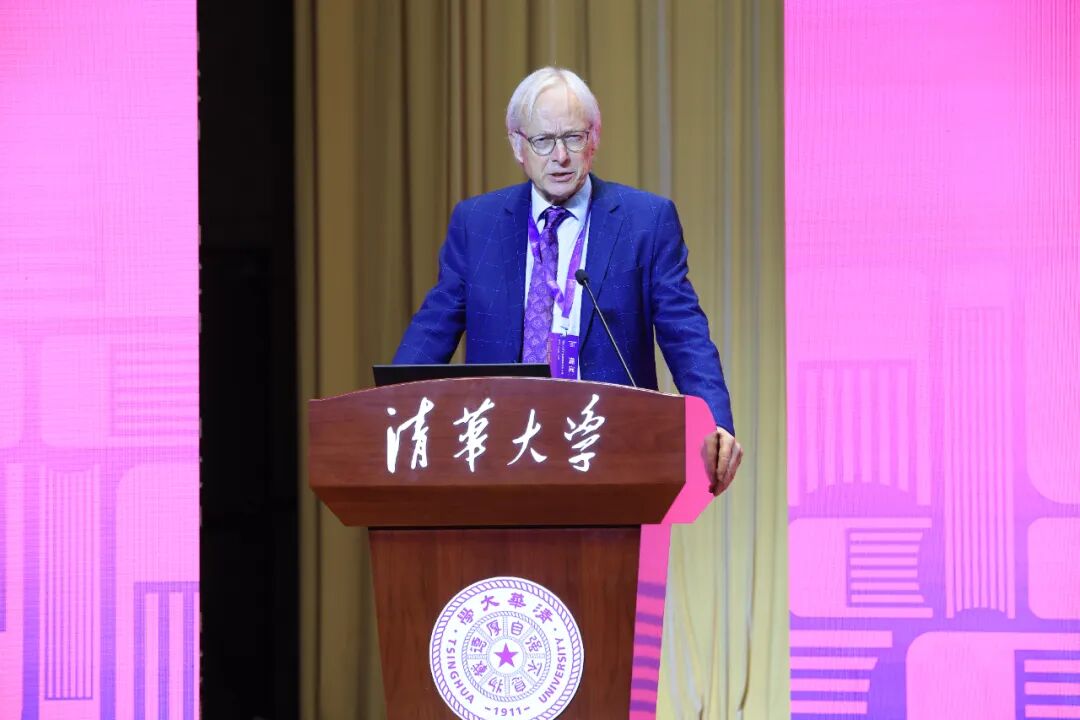
英文版
Ladies and Gentlemen,
It is an honor to stand here to speak at this 100 year celebration in the presence of so many distinguished university leaders and illustrious foreign scholars. An honor, yes, but also intensely intimidating. However, I guess that you are not interested in the storm in my heart: you want my speech. Which I will now proceed to give.
A while ago I walked to the gate of the Yuanmingyuan park close to our campus. The guard looked at my passport, and gently waved me through a special opening in the fence. As I walked into the park, I started musing about the contrast between this courteous behavior toward foreigners and the behavior of my European ancestors who had come in the 19th century to destroy the unique palace that stood here. China and the West all too often met each other across the barrel of a gun: not the best way of starting a relationship.
Walking further into the park, I saw the many fish swimming peacefully in the ponds. Clearly they were happy, and I was reminded of the Happiness of the Fish, one of the classics in Chinese literature and philosophy that has become part of our world heritage. What we learn from this dialogue is that it is a subtle matter to really know what is going on inside another living being. But sometimes it is easy. The next animals in the park seemed unhappy. The ducks were very nervous, and I could understand that, given the proximity of a famous Peking Duck restaurant near the Tsinghua campus. On a celebration day like today with lunches and dinners, the ducks in Yuanmingyuan will even feel that their risk of ending up in that place is higher than usual. On the other hand, the beautiful black swans in the lake seemed much more relaxed. This was no doubt because they know that there are no plans yet to open a Peking Swan restaurant in our Haidian district.
My first encounter with the Tsinghua Humanities was in 2004 when I met with Professor Wang Lu, who walked here with me for an afternoon, and told me of the amazing history of Tsinghua as a positive outcome of one more violent encounter with the West: the Boxer War. Ever since, I have felt at home on this graceful enclave which one might describe as an American-style campus university with, as the famous expression goes, 'Chinese characteristics'. When I started teaching at Tsinghua, philosophy was still housed in Xinzhai, an old building with lots of atmosphere, whose shape looked exactly like the character 'Wang'. Clearly, and very rightly, philosophy had been given a royal residence. Of course, we now live in the more futuristic modern Humanities building, housing the repository of the famous bamboo slips. It is an honor to do my work right on top of a Chinese national cultural treasure, and I can reassure our university leaders. I always walk slowly and carefully when I climb the stairs to my office, so that I do not break anything.
The Tsinghua philosophy department turned out to yield many encounters with interesting colleagues, such as Professors Huang Yusheng, Tang Hao, or Asher Jiang, who impressed me with their deep philosophical understanding and international erudition. Our working languages were both English and German testifying to their broad outlook. And even short chance encounters could be surprising, such as a memorable conversation with Professor Zhu Donghua about the subtleties of classical Christian theology. But the deepest debt I incurred was to professor Wan Junren who supported our logic center all the way, and who has always remained a personal friend over the years. I still remember a visit of his to Amsterdam where I took him to a famous Museum cafe overlooking the historical harbor from which ships used to sail to China in the 17th century. I had to leave Junren for a moment, smoking quietly as he often did in those days. And then from a distance, I noticed how a nice Dutch lady walked up to his table and asked for a light for her cigarette, clearly because she felt that he was an interesting guy. I thought: that is how gentle and easy East - West contacts can be.
But my closest colleague here is Professor Liu Fenrong, my codirector of the Tsinghua logic center. Yes, you heard it right. Logic is what we pursue there: the systematic study of the general laws governing correct thinking. And we translate that into concrete research projects sitting at a crossroads between philosophy, mathematics, computer science and other academic disciplines.
But for us, an interest in logic at Tsinghua also means an interest in the long history of logical thinking in Chinese culture since Antiquity, which is at the same time a rich tale of intellectual contacts between China, India and the West.But let me return to the bamboo slips in the Humanities building. Are they really the greatest Chinese national treasure to be found on the Tsinghua campus? Of course not. The greatest treasure are the students, an endless stream of talent that keeps flowing year by year. Teaching at Tsinghua means working with these young minds, and helping them enter into the world community of my field of logic, and the academic world at large. Over my many years here, I have witnessed a steady growth in preparedness and sophistication of the students we teach, every new course is a voyage of discovery.
In addition to transfer of knowledge and skills to my students, I also try to convey the spirit of open-mindedness and humor that enlivens academic life at its best. I can see some of you looking puzzled now: "Humor! What is that good for?" So let me explain. There was a lot of mention in today's talks about AI threatening academic life as we used to know it. But I myself think that there is a far greater danger threatening us university professors, namely, that of taking ourselves too seriously. And against that perennial danger, there is only one known effective medicine: namely, humor.
As you all know, teaching in China has many flavors of a close family relation. Now, my academic family ancestry, according to the famous Mathematical Genealogy website, goes back to Leibniz, the great European thinker who took China very seriously. So, my former PhD student Liu Fenrong, too, has Leibniz as an ancestor. And graduate students in this theatre who join me will also acquire the Leibniz connection for free.
But I also noticed a different line of thinking. Some years ago at a conference in Chongqing, a colleague presented a chart with generations of Chinese logicians, where to my great pleasure, I saw myself listed with some of the great older generation of professors who helped to revive logic in China after the difficult 1960s. So it seems that there is also a sort of reverse genealogy: by teaching Chinese students one becomes a little bit Chinese. I can see that change in some daily habits, like drinking hot water as the cure for truly everything, but also in my evolving mind set. But let me not bore you here with a personal account of my gradual 'sinification'. It is a slow but always ongoing process.
Instead, thinking not of myself but of others, let me return to my Chinese ancestry. Tracing its line backward in time, I arrive at Jin Yuelin, the founder of the philosophy department at Tsinghua and the person who introduced modern logic to your country. I deeply admire that first generation of Chinese students who went abroad, and had to navigate the encounter of two cultures without all the electronic information and other aids that students have today. We all stand on their shoulders. It is an honor to be a Jin Yuelin professor at Tsinghua continuing his tradition, and this feeling is also shared by all my colleagues in this group, coming from Europe, New Zealand, and soon also the US.
Ladies and gentlemen, it is an often-heard cliche that astronauts in space looking down at Planet Earth can see the Great Wall. Maybe they can, but what that means is that they see something that divides China from the rest of the world. Yet, if they look more closely, they will also see the Tsinghua campus, and astronauts with the sharpest eyes will even pick out our Humanities Building on that campus. So what they see then is the opposite of the Great Wall, they see open windows from China into the shared international world of scholarship and research that unites people from all cultures, continents and races.
I warmly congratulate the Tsinghua Humanities with their first hundred years of existence. For me and many other foreigners working at Tsinghua, it is a privilege to be a small part of your great enterprise. May you flourish and light up the world!


